
The team painted our kitchen cabinets, and we couldn’t believe the difference. The doors and drawers have a smooth, factory-like finish, and the new color made our entire kitchen feel more modern.
Kitchen Cabinet Painting in Pasadena, CA
Pasadena Elite Painting is Los Angeles County's trusted expert in kitchen cabinet painting, specializing in degreasing, bonding primers and sprayed waterborne alkyd enamel. We offer door removal and off-site finishing alongside on-site box work.
Our team provides a hard, level, factory-like surface, delivering durable kitchens for homes and refinished millwork for both residential and commercial projects. Fully licensed (CSLB #585047), insured and bonded, we handle everything from a single island to a full kitchen and butler's pantry.
From cutting kitchen grease out of a door edge that looks clean to hanging doors on a rack so the enamel levels without a single sag, our team handles every detail. Serving Pasadena, San Marino, Arcadia and South Pasadena, we ensure fast, efficient service and deliver reliable, professional and hard-wearing results on every cabinet painting project.
- Doors sprayed, not brushed
- Degreased before any sanding
- Kitchen stays usable through the job
- Licensed, insured and bonded
Reviews
What clients say about our cabinet work
The exterior paint had faded badly from years of sun exposure. After the project was completed, our home had stronger curb appeal and a fresh, updated appearance. The trim work looks especially sharp.
Our bathroom painting project came out beautifully. Clean edges and a flawless finish!
We needed our office repainted without creating a major disruption for employees. Pasadena Elite Painting handled the project efficiently and gave the entire workspace a brighter, more professional appearance.
The painters took great care around our furniture, flooring, and fixtures. Our walls and ceilings look fantastic, and there were no drips or messy edges left behind.
Our new accent wall looks perfect. It completely changed the feel of the room.
Pasadena Elite Painting helped us choose colors that complemented our flooring and natural lighting. The finished interior feels warm, coordinated, and much more inviting. We are extremely happy with the transformation.
Beautiful exterior painting and excellent workmanship from beginning to end.
01
What your cabinets are made of decides what can be done
Cabinet painting is a coatings problem before it is a colour problem. The substrate sets the primer, and the primer is what stops the finish peeling off a door edge in eight months.
| Substrate | Common in | Behaviour | Preparation and primer |
|---|---|---|---|
| Solid oak, maple or birch | Pre-1990 kitchens across older Pasadena homes | Takes coating well, but open oak grain telegraphs through | Degrease, sand, grain filler where a smooth finish is wanted, then bonding primer |
| Original 1920s painted millwork | Craftsman and Spanish Revival kitchens and pantries | Multiple old coats, often alkyd, sometimes lead-era underneath | Lead-safe practices, degloss, spot-strip failures, shellac-based primer |
| Thermofoil and laminate | 1990s and 2000s remodels | Non-porous, and peels at the door edges once heat has got to it | Degrease, scuff, specialist bonding primer, and lifted foil repaired or replaced first |
| MDF doors, factory finished | Modern flat-panel and shaker kitchens | Very stable and smooth, but swells badly if water reaches a cut edge | Light scuff, bonding primer, and sealed edges wherever the panel has been cut |
| Melamine box interiors | Most kitchens built after about 1985 | Slick and unforgiving of any primer that is not made for it | Usually left as they are, or bonding-primed where the interiors are being done too |
| Previously sprayed cabinets | Kitchens refinished once already | Depends entirely on what went underneath the last time | Adhesion test first, then either scuff and recoat or strip back where it fails |
02
How a cabinet refinish actually runs
Roughly a week for a normal kitchen, most of it spent on preparation and curing rather than on colour. The kitchen stays usable throughout apart from the doors being off.
Label and remove
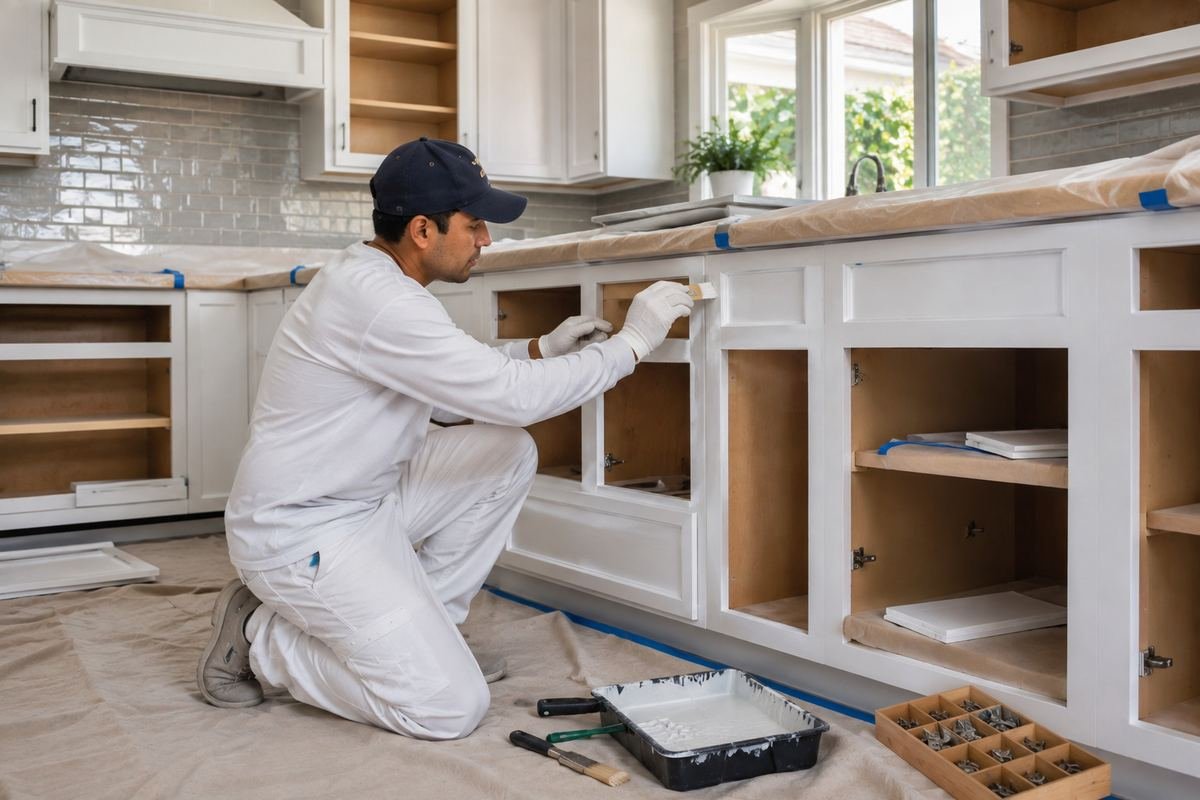
Every door and drawer front comes off and is labelled to its opening, along with hinges and hardware. Cabinets are not symmetrical after twenty years of adjustment, and a door rehung in the wrong opening never sits right again.
Degrease properly
Kitchen grease is invisible and it is the single biggest cause of cabinet finishes failing. Doors and frames are cleaned with a degreaser, particularly around the range, the extraction and the handle areas, then rinsed. Sanding a greasy door just drives the contamination into the surface.
Sand and repair
Everything is scuff-sanded to break the existing sheen. Dents and chipped edges are filled, loose joints are re-glued, and open grain is filled where a smooth modern finish is the goal rather than a grained one.
Prime for the substrate
Bonding primer on slick or previously finished surfaces, shellac-based primer where tannin or old alkyd could bleed through, and everything sanded again once the primer has cured. This is where a good cabinet job separates from a bad one.
Spray the finish
Doors and drawer fronts are sprayed flat on racks, so the enamel levels out under gravity instead of sagging on a vertical face. Boxes and face frames are sprayed in place behind full containment, with the rest of the kitchen sealed off.
Cure, then rehang
Waterborne alkyd enamel is touch dry quickly but continues to harden for days. Doors go back on once they are handleable, and we tell you honestly how long to be gentle with them before the finish reaches full hardness.
03
Finish, colour and hardware decisions
Three decisions change the outcome more than the colour does, and all three are easier to make before the doors come off than after.
Sheen
Satin and semi-gloss are the working range. Satin hides more of the substrate and reads softer, which suits period kitchens in older Pasadena homes. Semi-gloss cleans slightly better and looks crisper on a modern shaker door, but it shows every flaw in the preparation underneath, so it demands more sanding.
Grain
Oak grain will read through paint unless it is filled. Some clients want that, because it keeps the cabinetry looking like wood rather than like a moulded panel. Others want a completely smooth surface, which means grain filler and additional sanding passes. It is a real fork in the job and it changes the labour.
Hardware and hinges
New handles rarely land on the old drill centres. If you are changing hardware, decide before the doors are prepped so the old holes can be filled and re-drilled while the door is off and unfinished. Exposed period hinges can be cleaned and reused or replaced, but that choice affects how the door sits.
When refinishing is not the right answer
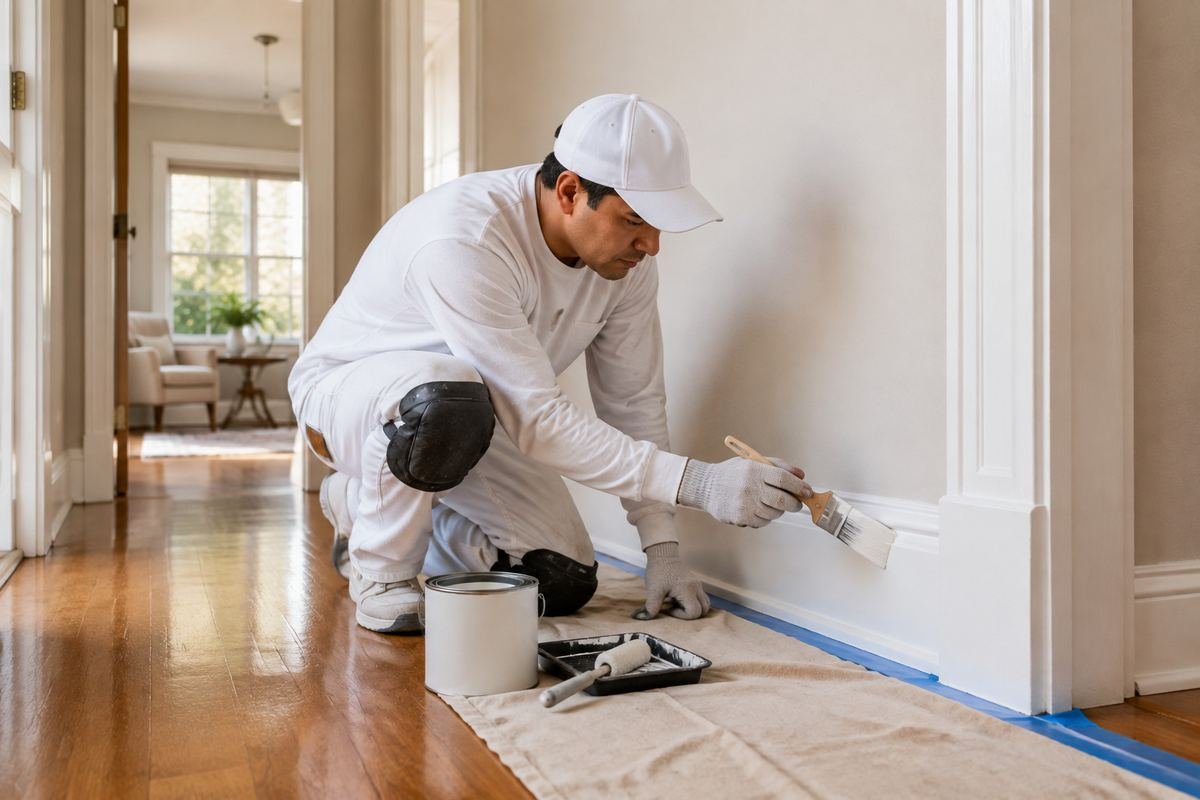
Refinishing works when the boxes are sound and the layout works. It does not rescue water-damaged particleboard at the sink base, doors that have delaminated, or a kitchen where the real complaint is the layout rather than the colour. We will say so at the walk-through instead of taking on a job that cannot deliver. Built-in bookcases, bathroom vanities, laundry cabinetry and period butler's pantries all take the same process and are frequently added to a kitchen job while the spray setup is already in the house, alongside interior house painting.
04
Frequently asked questions about kitchen cabinet painting
Can I use my kitchen while the cabinets are being painted?
Yes, with the doors off. The appliances, sink and worktops stay available, and the boxes are sprayed behind containment on one or two of the days. What you lose is the doors for most of a week and the use of the immediate work zone while spraying is happening. We agree the sequence so the fridge and the sink never go out of service on the same day.
Will the finish chip like a normal wall paint?
Not if the right product is used. Waterborne alkyd enamel is formulated for cabinetry and trim: it levels like an oil-based enamel and cures to a genuinely hard film, unlike a wall paint, which stays comparatively soft and will mark at every fingertip. It still needs a curing period before heavy use, and we tell you what that period is.
Do you paint the inside of the cabinets too?
Only when you ask, and it costs more because every shelf and interior face has to be prepped and coated. Most clients paint the exteriors and leave melamine interiors as they are, since the interiors are rarely visible and melamine is a difficult surface to coat well. Open shelving and glass-fronted units are a different matter and are almost always done.
Can oak cabinets be made to look smooth and modern?
Yes, with grain filling. The open pores of oak are filled, sanded back and primed before the finish goes on, which adds preparation time but produces a surface with no grain reading through it. Without that step the grain telegraphs through the enamel, which some people like and others are disappointed by, so it is worth deciding deliberately.
What about cabinets in a pre-1978 kitchen?
They are treated as lead-era until testing says otherwise, which means no dry open sanding, contained debris and careful cleanup. Original 1920s pantry and kitchen millwork in Pasadena homes is often on its fifth or sixth coat, and where the stack has alligatored, spot-stripping is a better answer than adding another layer on top.
How long before I can put everything back in the kitchen?
Doors and drawer fronts get rehung once the enamel is handleable, usually a day or two after the last coat. Full hardness takes longer, and during that window the finish is still vulnerable to sticking and pressure marks, so we recommend leaving felt bumpers slightly proud and not stacking heavy items hard against a painted face until it has fully cured.
Do you spray on site or take the doors away?
Both, depending on the kitchen. Doors and drawer fronts go to a controlled spray environment where they can be racked flat and kept dust free. The boxes and face frames cannot travel, so they are sprayed in place behind sealed containment with extraction, or brushed and rolled with a levelling enamel where spraying is not practical in that room.
05
Related painting services
Cabinet work is usually part of a wider interior project.
- Interior House Painting
- Drywall Repair & Painting
- Ceiling Painting
- Wallpaper Removal & Repainting
- Historic Home Restoration Painting
- Venetian Plaster & Specialty Finishes
Painting service areas
Cabinet refinishing across every community we cover around Pasadena.
Refinish the kitchen without replacing it
Send photographs of the doors and the boxes. We will tell you whether refinishing is the right call for your kitchen or not.
- Free written estimate
- Doors sprayed flat for a level finish
- Licensed, insured and bonded