
Beautiful exterior painting and excellent workmanship from beginning to end.
Limewash & Mineral Coatings in Pasadena, CA
Pasadena Elite Painting is Los Angeles County's trusted expert in limewash and mineral coatings, specializing in slaked-lime limewash application, breathable mineral silicate finishes and vapour-permeable stucco recoats. We offer multi-coat limewash builds for masonry and lime plaster alongside elastomeric options where crack bridging matters more than breathability.
Our team provides careful substrate dampening and coat-by-coat opacity building, delivering a soft, variegated finish for homes and durable mineral protection for both residential and commercial masonry. Fully licensed (CSLB #585047), insured and bonded, we handle everything from one accent wall to a full exterior recoat.
From wetting a wall correctly before the first pass to building even opacity across several thin coats, our team handles every detail. Serving Pasadena, La Cañada Flintridge, San Marino and Sierra Madre, we ensure fast, efficient service and deliver reliable, professional and breathable results on every limewash and mineral coating project.
- Sample panels cured before you commit
- Substrate dampened, not just cleaned
- Fully vapour-permeable systems
- Licensed, insured and bonded
Reviews
What clients say about our specialty finishes
We hired the team to paint several units in our rental property. The walls, doors, and trim were finished neatly, and each space looked fresh and ready for new tenants. The results made a noticeable difference.
Our commercial storefront needed an update, and Pasadena Elite Painting delivered exactly what we wanted. The new color scheme looks clean and professional, giving the building a much stronger street presence.
The ceiling painting came out smooth and even. The room feels much cleaner and brighter now.
We had peeling paint and minor surface damage on the outside of our home. The team prepared the problem areas carefully before applying the new paint. The finished exterior looks smooth, durable, and professionally restored.
Great work on our doors, baseboards, and interior trim. Every line looks crisp and precise.
Pasadena Elite Painting transformed our older home with fresh interior and exterior paint. The preparation work was thorough, the color coverage was consistent, and the finished surfaces look outstanding. The entire property now feels well maintained and updated.
Pasadena Elite Painting did a beautiful job repainting the interior of our home. The rooms look brighter, cleaner, and completely refreshed.
01
What limewash and mineral coatings actually are
Limewash is not paint, even though it goes on with a brush and covers a wall in colour. It is slaked lime suspended in water, and once applied it cures through carbonation, reacting with carbon dioxide in the air and converting back into calcium carbonate, essentially the mineral the original limestone came from.
That chemistry is what produces the look. Light refracts off tiny calcite crystals in the cured finish, giving the soft, variegated glow that a flat film-forming paint cannot reproduce. It also behaves differently going on. Limewash draws into the substrate rather than sitting on it as a surface film, which is why the wall has to be dampened correctly first. Too dry and the finish goes on chalky and powdery. Too wet and it fails to bond. Opacity builds gradually, coat by coat, instead of covering in a single pass.
- Traditional lime plaster walls, inside and out.
- Stucco exteriors, particularly on period and historic homes where breathability is the point.
- Exposed masonry and brick that needs a breathable finish rather than a sealed film.
- Accent walls and interior features where the variegated texture is the design intent.
- Properties coming off a failing modern paint film and going back to a breathable mineral system.
Limewash, elastomeric and standard paint compared
| Coating | Breathability | Crack bridging | Look | Best suited to |
|---|---|---|---|---|
| Limewash and mineral silicate | Fully vapour permeable | None, it is not designed to bridge | Soft, variegated, matte | Historic stucco, lime plaster, breathable masonry |
| Elastomeric coating | Lower, but still moves some vapour | Strong, bridges hairline cracking | Slightly textured, opaque, uniform | Sound modern stucco with existing hairline cracks |
| Standard acrylic paint | Moderate | Minimal | Flat and uniform | Sound substrates with no moisture concerns |
| Cement-modified limewash | Restricted | Slight | Similar to limewash, flatter | Durability-led work, and not historic buildings |
Adding cement to a limewash mix raises durability and restricts breathability, which is exactly why we avoid cement-modified limewash on historic buildings, where vapour permeability is the entire reason for choosing the system.
02
Getting the look right the first time
Because limewash builds colour gradually and reads differently on a wall than it does in a pot, the real risk on a limewash project is not the chemistry. It is expectation.
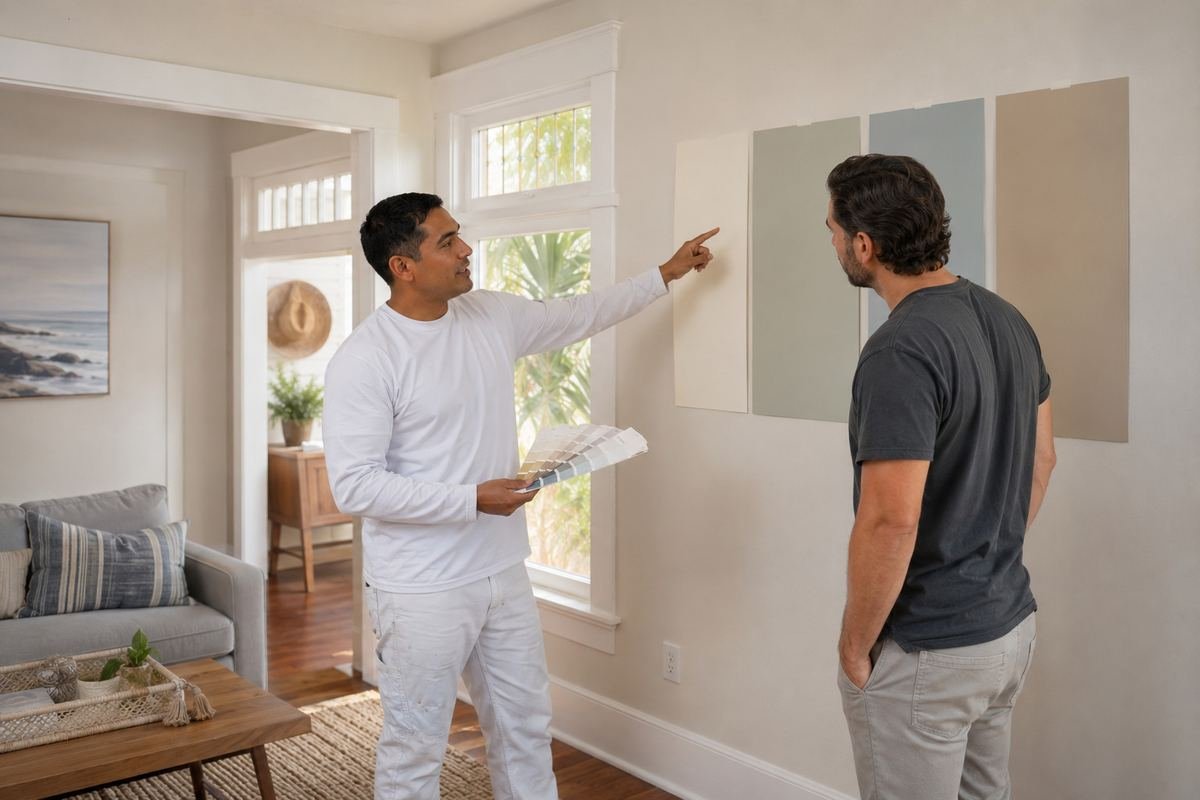
A single test coat almost never shows the final result. We put sample patches up in the actual light the wall gets, let them cure through a full carbonation cycle, and review them with you before committing to a whole elevation. Rushing that step is the most common reason a limewash job ends up looking patchy rather than deliberately variegated.
Dampening also shifts with the season here. Hot, dry summer conditions pull moisture out of a wall much faster than a mild spring morning does, which changes how quickly a section has to be worked before it sets. Santa Ana conditions make it faster again, and dusty. We schedule and sequence limewash around those conditions instead of treating every wall the same regardless of the day.
03
What shapes the project, and how it runs
Coat count and substrate condition drive a limewash project far more than wall area does.
Substrate condition
Sound lime plaster or stucco needs little preparation. A wall coming off a failing modern paint film usually needs that film removed first, so the new coating can bond and the wall can breathe again.
Coats and opacity
Limewash opacity builds gradually, so full even coverage takes more passes than a standard paint job. That is a feature rather than a fault, and it is why coat count is agreed at the estimate rather than discovered on site.
System and access
Pure limewash, mineral silicate coatings and elastomeric systems each have their own preparation, application and cure requirements. Two-storey exteriors and the hillside properties common in La Cañada Flintridge and Altadena add access time.
On-site assessment
We evaluate the substrate, check for prior coatings and confirm that limewash or a mineral coating is genuinely the right fit rather than the fashionable one.
Written scope and recommendation
Preparation, coat count and the finish appearance you should expect, in writing before anything starts.
Substrate preparation
Failing prior coatings removed where needed, the wall cleaned, and correct dampening immediately ahead of application.
Application
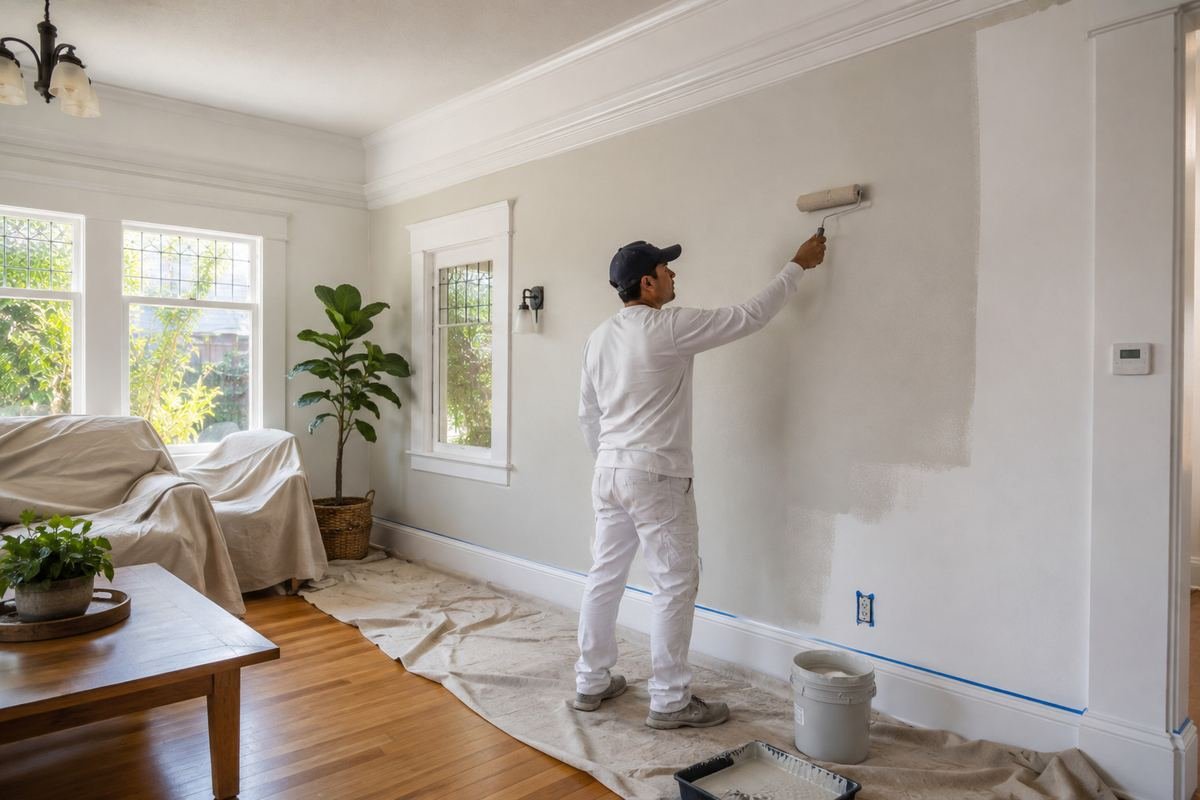
Several thin coats, each allowed to carbonate before the next, building opacity and the characteristic variegated texture gradually rather than forcing coverage.
Final walk-through
Reviewed in natural light once cured, because limewash colour and texture continue to develop after the last pass.
04
Frequently asked questions about limewash
How is limewash different from regular paint?
Limewash is slaked lime in water that cures by reacting with carbon dioxide in the air, rather than a film that dries as water or solvent evaporates. It draws into the substrate instead of sitting on top of it, produces a soft variegated surface instead of a flat uniform colour, and stays fully vapour permeable so the wall can still release moisture.
Can limewash go over modern paint?
Not directly. Limewash needs a breathable, mineral-compatible substrate to bond and carbonate correctly. Where a wall carries an existing non-breathable film, that film generally has to come off first, and how difficult that is depends entirely on what was used and how well it is still adhering.
Will limewash crack like paint does?
It does not crack in the way a film does, because it is not a film. It also does nothing to bridge existing cracks, which elastomeric is designed for. On a stucco wall with active hairline cracking we will either recommend elastomeric instead, or carry out crack repair before limewash goes on.
Does limewash need recoating more often?
It weathers rather than fails, which is a different relationship from a paint film. Instead of peeling or blistering it gradually erodes and softens, and a refresh coat can go straight over it without stripping. Many people find that trade acceptable, because the maintenance is simpler even if it comes round sooner on exposed elevations.
Can you tint limewash to a specific colour?
Within the palette lime allows. Limewash takes mineral pigments, which gives a range of earth tones, soft whites, ochres and greys, and it will not produce the saturated or very bright colours that modern tinting systems can. The variegation is also part of the result, so a limewash wall never reads as one flat uniform colour.
Is limewash suitable for interior walls?
Yes, and it works particularly well on feature walls, fireplaces and in period rooms where a flat modern paint looks too clinical. Interiors carbonate more slowly than exteriors because there is less air movement, so the schedule allows more time between coats.
How soon can you start a limewash project?
Scheduling depends on size, preparation needs and weather, since both dampening and cure depend on conditions. Most projects can be booked within a few weeks of the estimate, and we avoid committing to limewash exteriors during a wind event or a heat spike because neither produces a good result.
Is there a guarantee on the finish?
Coverage is set out in the estimate documentation and in our terms of service. Limewash is a living finish that weathers rather than a sealed film, so your estimator will explain what that means for your wall before you decide on it.
05
Related painting services
Mineral coatings pair naturally with the other breathable, period-appropriate finishes.
- Historic Home Restoration Painting
- Stucco Painting
- Brick & Masonry Painting
- Venetian Plaster & Specialty Finishes
- Exterior House Painting
- Interior House Painting
Painting service areas
Limewash and mineral work across every community we cover around Pasadena, concentrated in the historic and foothill streets.
Get a finish that actually breathes
Limewash and mineral coatings reward patience and the right technique, and they protect historic stucco and masonry instead of sealing it in.
- Free written estimate
- Sample panels cured before commitment
- Licensed, insured and bonded