
Excellent painting and careful preparation. Our house looks amazing!
Garage Floor Epoxy Coating in Pasadena, CA
Pasadena Elite Painting is Los Angeles County's trusted expert in garage floor epoxy coating, specializing in resin-and-hardener epoxy systems, colored-aggregate and chip flooring and UV-stable topcoat protection. We offer solid-colour epoxy and terrazzo-look chip finishes.
Our team provides full concrete surface preparation before coating, delivering a hard, chemically resistant floor for homes and durable protective flooring for both residential and commercial projects. Fully licensed (CSLB #585047), insured and bonded, we handle everything from a single-car recoat to a multi-bay workshop floor.
From profiling a slab so the resin actually bonds to it to timing the broadcast of colour flake before the working window closes, our team handles every detail. Serving Pasadena, La Cañada Flintridge, Altadena and Arcadia, we ensure fast, efficient service and deliver reliable, professional and hard-wearing results on every garage floor epoxy project.
- Slab ground and profiled first
- Moisture tested before coating
- UV-stable topcoat where sun reaches
- Licensed, insured and bonded
Reviews
What clients say about our floor coatings
We hired Pasadena Elite Painting to repaint our living room, kitchen, and hallway. The lines around the trim and ceilings came out incredibly clean, and the new colors transformed the entire space. Everything was left neat when the work was finished.
Our home’s exterior looks brand new again. The finish is smooth, even, and professionally done.
The team painted our kitchen cabinets, and we couldn’t believe the difference. The doors and drawers have a smooth, factory-like finish, and the new color made our entire kitchen feel more modern.
Friendly service, beautiful results, and great attention to detail.
Pasadena Elite Painting repaired several damaged areas of drywall before repainting our bedroom. The repaired sections blend perfectly with the surrounding walls, and the finished room looks clean and polished.
The exterior paint had faded badly from years of sun exposure. After the project was completed, our home had stronger curb appeal and a fresh, updated appearance. The trim work looks especially sharp.
Our bathroom painting project came out beautifully. Clean edges and a flawless finish!
01
Garage floor epoxy systems we install
Epoxy is a two-part resin and hardener that cures by chemically cross-linking into a dense, chemically resistant film. That is the whole reason it became the standard for garage and industrial floors: it resists oil, fuel, hot tyre pickup and daily abrasion in a way a painted film cannot.
| System | Best for | What it adds |
|---|---|---|
| Solid-colour epoxy | Standard single or two-car garage | A clean, uniform, hard-wearing surface |
| Colored-aggregate and chip | Garages that want a decorative terrazzo-look finish | Flake colour that hides minor debris and tyre marks between cleanings |
| Epoxy plus polyaspartic topcoat | Garages with direct sun through an open door or a skylight | UV stability, which prevents the surface chalking that epoxy alone suffers |
| Crack-repaired epoxy system | Slabs with existing cracking or pitting | A sound substrate, so damage does not telegraph through the finish |
| Multi-bay and workshop system | Two and three-car garages and converted workshops | A consistent finish across a larger continuous floor area |
| Steel and hardware protection | Exposed steel elements in the same space | Corrosion protection extended to the metalwork, not just the slab |
Why epoxy is not simply floor paint
Standard latex or acrylic concrete paint is a water-based coating that dries as the water evaporates and the binder coalesces, essentially the same chemistry used on an interior wall. It goes on easily and touches up easily, and it never chemically bonds to the concrete, which is why painted garage floors peel, chip and hold tyre marks within a few years. Epoxy cross-links into a genuinely different material sitting on the slab, dense enough to take oil, fuel, hot tyre pickup and abrasion. The trade-off is that it demands real surface preparation, because epoxy over a poorly profiled or contaminated slab will fail early no matter how good the product is.
One detail that gets missed in Pasadena garages: epoxy on its own is not the full system where the door stands open through a hot afternoon. Ultraviolet exposure chalks the surface of epoxy over time, the same powdery degradation that affects any UV-exposed film. That is why sun-exposed work is finished with a UV-stable polyaspartic or polyurethane sealer, which protects the colour and gloss underneath and extends the life of the whole system.
02
What shapes your garage floor epoxy project
Every garage floor is different once you look past the square footage. These are the factors that genuinely change scope and time on the job.
Concrete condition
Cracks, pitting, prior coatings and moisture in the slab all change how much preparation is needed before epoxy will bond properly. A slab that reads wet on a moisture test is a different project from one that does not.
Size, layout and system
A single-car garage is not a three-bay garage or a converted workshop floor. A solid-colour coating is a simpler application than a multi-step chip system with a broadcast layer and a topcoat over it.
Sun exposure and removal
Garages with doors open for long stretches, or with skylights, need the UV-stable topcoat, which adds a step. A failing prior epoxy or paint coating has to be ground or stripped off before anything new goes down.
Cure time is the last factor and the one people underestimate. Epoxy hardens through an exothermic chemical reaction rather than by drying, and that reaction has to finish before the garage sees vehicle traffic again. We plan the schedule around it and tell you honestly when the floor is ready for foot traffic and when it is ready for a car. The only way to know exactly what your slab needs is a walk-through, and the written estimate that follows names the preparation, the system and the topcoat.
03
How the process works
Eight steps, and the first three decide the outcome. Nothing about the finish coat can rescue a slab that was not prepared.
Inspect the slab
Cracks, pitting, moisture issues and any existing coating that has to come off. Moisture testing matters, because vapour driving up through a slab will lift a coating off from underneath regardless of how well the surface was prepped.
Grind and profile
The concrete is diamond ground to an open profile so the epoxy has a mechanical key. This is the step that separates a floor that lasts from one that peels in sheets at the first hot tyre.
Repair cracks and pitting
Damaged areas are filled and levelled before coating begins, so the repair does not read through the finished surface.
Apply the epoxy base
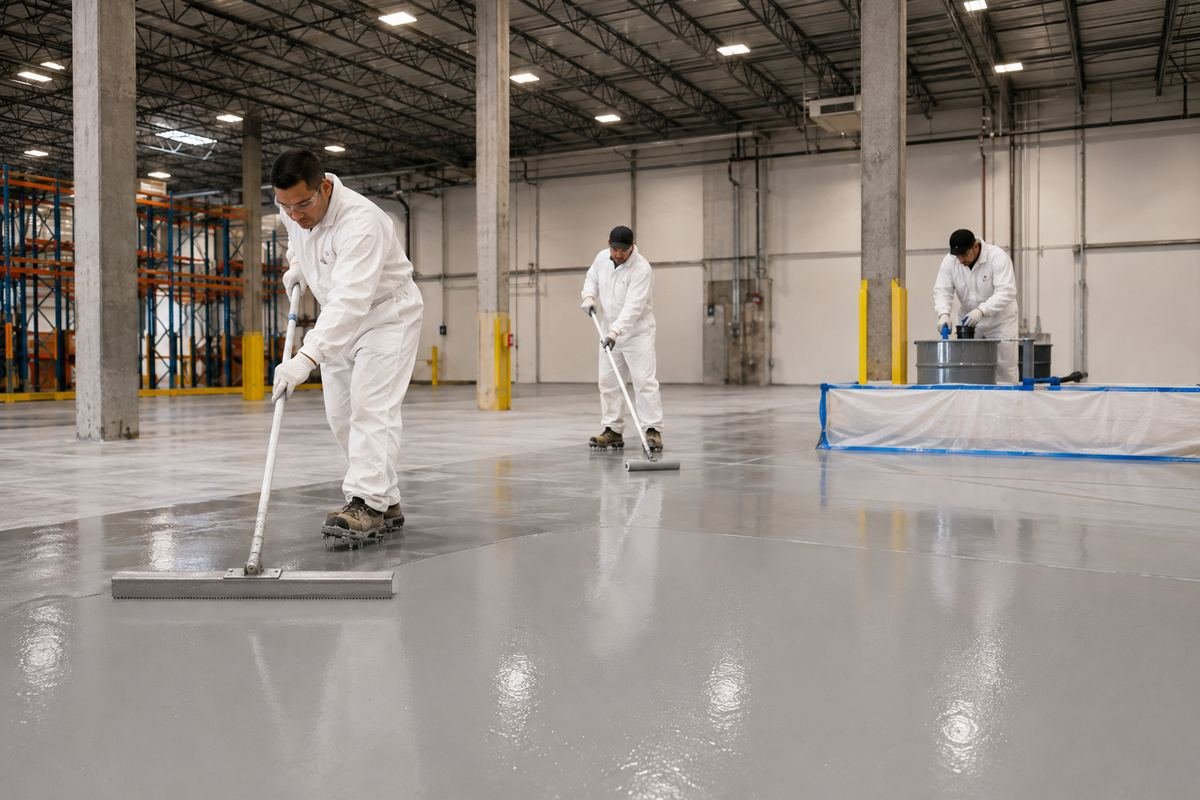
Resin and hardener are mixed on site and applied inside the working window, before the chemical cure starts. Mixed epoxy does not wait, so the layout and the crew size are planned around the pot life.
Broadcast the flake
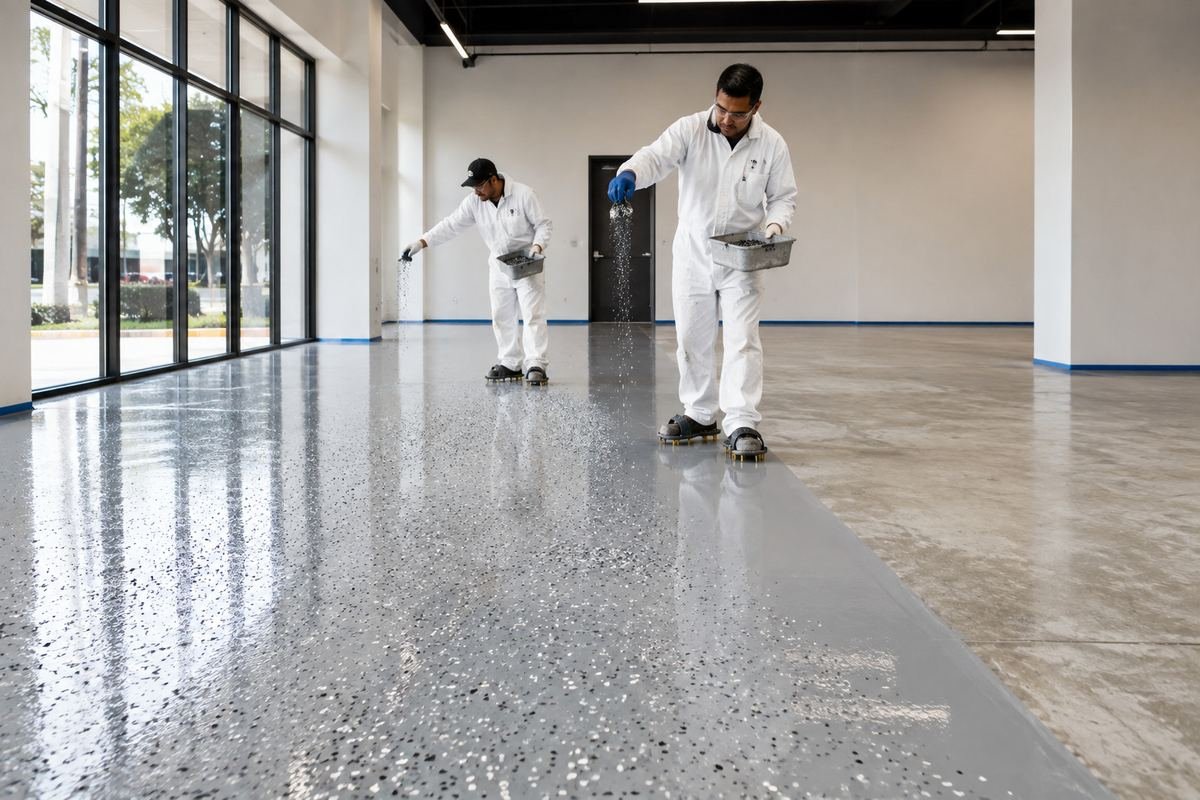
On colored-aggregate and chip systems the flake is broadcast into the wet epoxy at this stage, worked for even distribution rather than dropped in patches.
Topcoat
A UV-stable polyaspartic or polyurethane sealer where sun exposure warrants it, which is most garages here that keep a door open.
Cure
The exothermic reaction runs to completion before the garage returns to vehicle use. Light foot traffic comes back earlier than vehicle traffic, and we give you both timings.
Final walk-through
Coverage, flake distribution and gloss evenness checked across the whole floor in daylight, not under a work lamp.
04
Frequently asked questions about garage floor epoxy
How long does garage floor epoxy take to cure before I can park on it?
Epoxy cures through a chemical reaction rather than by air drying, so it needs time to harden fully before it can take vehicle weight. Light foot traffic returns well before vehicle traffic does. We give you both timings for the specific system and topcoat installed, and they are on the written estimate rather than being made up on the last day.
Do I need a UV-stable topcoat, or is standard epoxy enough?
It depends on how much direct sun the garage gets. Where the door stands open for long stretches, or there is a skylight, a polyaspartic or polyurethane topcoat is worth having, because epoxy on its own chalks under ultraviolet exposure over time. In a fully shaded garage it is optional. We assess the exposure during the walk-through and say which case yours is.
Can epoxy be applied over cracked or damaged concrete?
Not directly. Cracks and pitting have to be repaired and the slab properly profiled so the epoxy bonds to a stable surface. Coating straight over damage is the single most common reason an epoxy floor fails early, and the damage usually telegraphs through the finish as well.
Do you offer decorative finishes, or only solid colours?
Both. Solid-colour epoxy is the straightforward option. Colored-aggregate and chip systems broadcast flake into the wet resin for a terrazzo-look surface that also hides minor debris and tyre marks between cleanings, which is why a lot of clients with working garages choose it.
Can you remove an old, failing epoxy or paint coating first?
Yes. Grinding or stripping a failing prior coating is part of standard surface preparation when a floor already has one. It is quoted as its own line, because the labour varies enormously depending on what was used last time and how well it is still holding on.
Will epoxy work on a garage floor that gets damp?
Only once the moisture is understood. A slab pushing vapour up from below will lift a coating no matter how well the surface was prepared, so moisture testing comes first. Where readings are high there are moisture-mitigating primers designed for the situation, and we will name one rather than coating over the problem and hoping.
Do you coat workshop, storage and light commercial floors as well?
Yes. The same preparation logic scales up to workshops, storage bays and light industrial floors, where the systems get heavier and safety striping often comes into it. That work is covered on the industrial and protective coatings page.
Is there a guarantee on the finished floor?
Coverage is set out in the estimate documentation and in our terms of service rather than being promised in general terms on a web page. Ask your estimator to walk you through exactly what applies to the system you choose before you sign anything.
05
Related painting services
A garage floor is often one part of a wider property refresh. These are the services it most often runs with.
- Interior House Painting
- Exterior House Painting
- Stucco Painting
- Drywall Repair & Painting
- Industrial & Protective Coatings
- Commercial Building Exterior Painting
Painting service areas
Floor coating across every community we cover around Pasadena.
Stop parking on cracked, stained concrete
Tell us the size of the garage and what the slab looks like. We will assess the concrete and the sun exposure before specifying anything.
- Free written estimate
- Slab ground, not just cleaned
- Licensed, insured and bonded