
We needed our office repainted without creating a major disruption for employees. Pasadena Elite Painting handled the project efficiently and gave the entire workspace a brighter, more professional appearance.
Stucco Painting in Pasadena, CA
Pasadena Elite Painting is Los Angeles County's trusted expert in stucco painting, specializing in crack cutting and bedding, texture-matched patching and elastomeric coating systems. We offer chalk removal and masonry priming on sun-worn tract stucco.
Our team provides diagnosis before product selection, delivering crack-resistant walls for homes and phased elevations for both residential and commercial projects. Fully licensed (CSLB #585047), insured and bonded, we handle everything from a single garden wall to a full two-storey elevation.
From telling a shrinkage web apart from a movement crack running off a window corner to floating a patch that matches a 1950s sand float, our team handles every detail. Serving Pasadena, Temple City, Alhambra and San Gabriel, we ensure fast, efficient service and deliver reliable, professional and crack-resistant results on every stucco painting project.
- Cracks bedded, not caulked over
- Texture matched before coating
- Elastomeric only where it belongs
- Licensed, insured and bonded
Reviews
What clients say about our stucco work
The painters took great care around our furniture, flooring, and fixtures. Our walls and ceilings look fantastic, and there were no drips or messy edges left behind.
Our new accent wall looks perfect. It completely changed the feel of the room.
Pasadena Elite Painting helped us choose colors that complemented our flooring and natural lighting. The finished interior feels warm, coordinated, and much more inviting. We are extremely happy with the transformation.
Beautiful exterior painting and excellent workmanship from beginning to end.
We hired the team to paint several units in our rental property. The walls, doors, and trim were finished neatly, and each space looked fresh and ready for new tenants. The results made a noticeable difference.
Our commercial storefront needed an update, and Pasadena Elite Painting delivered exactly what we wanted. The new color scheme looks clean and professional, giving the building a much stronger street presence.
The ceiling painting came out smooth and even. The room feels much cleaner and brighter now.
01
Read the wall before you choose the coating
Stucco failure comes in a handful of recognisable patterns, and each one points at a different fix. Choosing a product before diagnosing the wall is how a repaint ends up looking worse in two years than the surface it covered.
| What the wall shows | What it actually is | Repair | Coating decision |
|---|---|---|---|
| Fine web of hairline cracks | Shrinkage and thermal movement in the finish coat | Wash, then bed the wider ones; the finest close under a bridging coat | 100% acrylic elastomeric is the right call here |
| Single straight crack from a window corner | Structural or seismic movement at a stress point, common on the Raymond Fault side of town | Cut out, bed with mesh or tape, texture match the patch | Elastomeric over the repair, standard acrylic acceptable elsewhere |
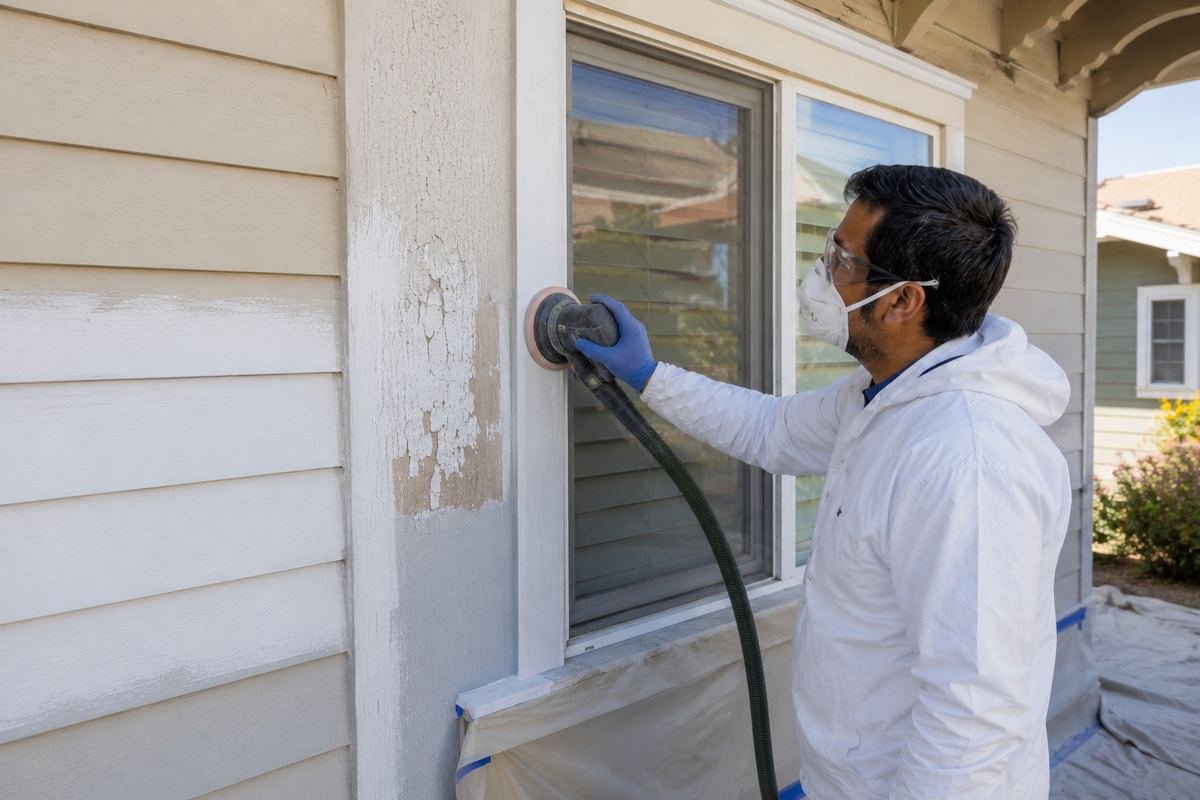
| Chalky white residue on your hand | Ultraviolet breakdown of the previous coating binder | Wash the chalk off completely, then test adhesion | Bonding or masonry primer before any finish coat |
| Blistering or coating peeling in sheets | Trapped moisture, or a film applied over chalk or damp stucco | Remove the failed film, find and fix the water source, dry the wall | Breathable acrylic or mineral system, never a thick elastomeric |
| White powdery bloom, usually low on the wall | Efflorescence, salts migrating out of the substrate | Dry-brush and neutralise, resolve the moisture path | Breathable mineral coating so the wall can still release moisture |
| Dark staining below windows or gutters | Water tracking from failed flashing or an overflowing gutter | Correct the water path first, then clean and prime the stain | Any system, once the source has been dealt with |
| Patches in a different texture | Previous repairs floated or trowelled without matching | Re-texture to match the surrounding field | Coating will not hide a texture mismatch, so it is fixed first |
02
How we repair a stucco crack so it stays closed
Pasadena sits on ground that moves, and a great deal of its housing is postwar tract stucco now on its second or third coating cycle. Cracks are normal. Cracks that keep coming back are a repair problem, not a paint problem.
Open the crack
The crack is cut out to a consistent width and depth rather than filled as a hairline. A sealant pushed into a hairline has nothing to grip and no room to move, which is exactly why it reopens in the first season.
Clean and dampen
Loose material blown or brushed out, and the substrate dampened where the patching material calls for it, so the repair cures rather than drying out and shrinking away from the edges.
Bed with mesh or tape
On active or wider cracks the repair is bedded with mesh so the patch spans the movement instead of transmitting it straight through to the new surface.
Build and texture match
The patch is built out to the surrounding plane, then textured to match the existing field: sand float, dash, lace, smooth trowel or whatever the house has. This is skilled work and it is the step that separates an invisible repair from a permanent scar.
Cure, then prime
New and repaired stucco is alkaline and needs to cure before coating. Masonry primer goes on the repair once it is ready, so the patch does not flash through the finish in a different sheen.
Coat the whole elevation
Repairs are never spot-coated on a wall being repainted, because a patch coated on its own will always read differently once the sun moves across the elevation.
03
Three coating systems, three different jobs
Elastomeric has a reputation as the premium option, and it is the wrong choice on a significant share of the walls we are asked to put it on.
100% acrylic elastomeric
A thick, flexible film that bridges hairline cracking and sheds water. Correct on sound stucco with a shrinkage crack pattern and no moisture problem. Wrong on a wall that needs to breathe, over a failing existing coat, or where water is entering from behind.
Standard 100% acrylic
The workhorse. Good colour retention, good adhesion over a properly prepared and primed wall, more breathable than elastomeric and easier to recoat next cycle. The right answer on most postwar tract stucco in Temple City, Arcadia and East Pasadena without a movement crack pattern.
Mineral silicate and limewash
Chemically bonds to masonry and stays highly vapour open. The right system on older stucco, on brick and block, and anywhere efflorescence or trapped moisture is in play. It also gives the soft, variegated look that suits Spanish Revival elevations, covered on the limewash and mineral coatings page.
Sheen and colour on stucco
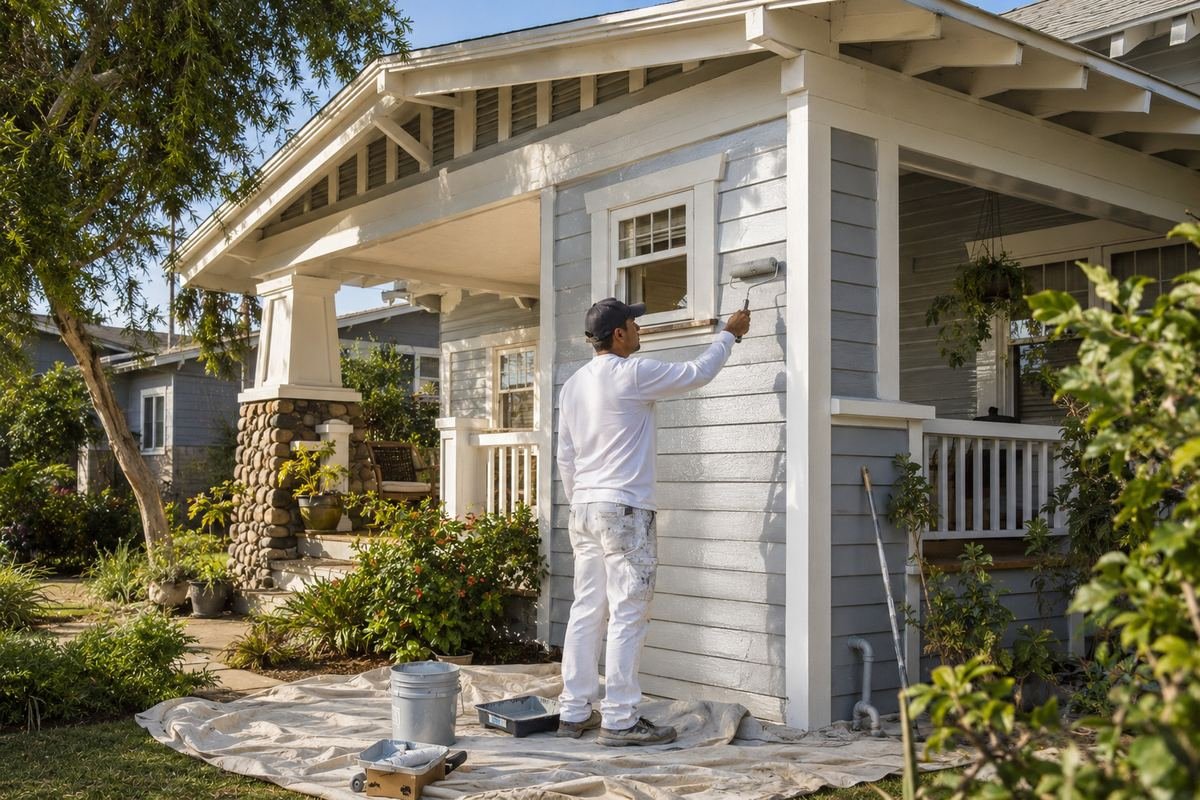
Flat and low-sheen finishes are standard on stucco, because texture plus sheen equals visible unevenness across a large wall. Colour runs deeper than the chip suggests. A full elevation in direct Pasadena sun reads noticeably lighter than a sample board indoors, and very dark colours on a south or west wall run hot, which accelerates both fading and the movement that opens the cracks in the first place. Sample areas go up on the wall itself and get looked at twice in a day before anything is ordered.
04
Frequently asked questions about stucco painting
Will painting stucco stop the cracks coming back?
Painting alone will not. Coating is flexible, not structural, so a crack that is still moving will telegraph through any film eventually. What extends the interval is cutting out and bedding the crack properly, matching the texture, and then choosing a coating with enough flexibility for the movement that particular wall has. Anyone promising paint fixes cracking permanently is selling rather than diagnosing.
Can new stucco be painted straight away?
No. Fresh stucco is highly alkaline and holds moisture, and coating it too early causes discolouration, poor adhesion and efflorescence. It needs a cure period and then a masonry primer designed for high pH. Where a schedule genuinely cannot wait there are coatings formulated for green stucco, and we will name one rather than gamble on a standard acrylic.
Does stucco have to be painted at all?
Integrally coloured stucco can be left alone, and washing plus spot repair is sometimes the honest recommendation. Once a wall has been painted, though, it is on a coating cycle permanently, because stripping stucco back to raw is not practical. We will tell you if your wall does not genuinely need a coat yet.
What is the difference between a fog coat and repainting?
A fog coat is a thinned cementitious slurry sprayed onto uncoated stucco to even out colour, and it keeps the wall breathable and unpainted. Repainting applies an acrylic or elastomeric film. If your stucco has never been painted and the problem is patchy colour rather than failure, a fog coat may be the better and lighter-touch option.
How do you match a texture from the 1950s?
By sampling it. We look at the aggregate size, the tool pattern and the depth, mix to match and practise on a board before touching the wall. Sand float, heavy dash and lace textures each need a different technique and material. On a large repair we put up a test patch and get your eyes on it before doing the rest.
Can stucco be sprayed, or does it have to be rolled?
Both, usually together: sprayed to get material into the texture quickly and back-rolled to work it into the surface and get even film build. Spraying alone on a coarse texture leaves shadowed low spots that appear the moment the sun moves across the wall.
Why does one elevation look so much worse than the others?
Orientation. South and west walls take far more ultraviolet load and far more heat cycling than north-facing ones, so they chalk, fade and crack first. It is common in Pasadena for a west elevation to be visibly finished while the north wall still looks serviceable. We will tell you whether the sensible scope is the whole building or the two elevations that are actually failing.
05
Related painting services
Stucco work usually sits inside a wider exterior scope. These are the services it most often runs with.
- Exterior House Painting
- Brick & Masonry Painting
- Limewash & Mineral Coatings
- Drywall Repair & Painting
- Historic Home Restoration Painting
- Commercial Building Exterior Painting
Painting service areas
The same crews and the same specification standards across every community we cover around Pasadena.
Get your stucco diagnosed before it is coated
Send a photograph of the cracking or book a walk-through. The crack pattern tells us which system the wall needs.
- Free written estimate including crack repair
- Texture matched by hand
- Licensed, insured and bonded