
The painters took great care around our furniture, flooring, and fixtures. Our walls and ceilings look fantastic, and there were no drips or messy edges left behind.
Historic Home Restoration Painting in Pasadena, CA
Pasadena Elite Painting is Los Angeles County's trusted expert in historic home restoration painting, specializing in Craftsman-era exterior repaints, lime-based stucco coatings and wood-trim restoration. We offer alkyd enamels for original siding and trim alongside breathable limewash for lime plaster and masonry.
Our team provides preparation calibrated to protect original woodwork and stucco texture, delivering historically accurate results for period homes and preservation-grade finishes for both residential and landmark commercial properties. Fully licensed (CSLB #585047), insured and bonded, we handle everything from single-elevation trim restoration to a full period exterior.
From researching a palette appropriate to the year a house was built to choosing a vapour-permeable system that will not trap moisture inside century-old plaster, our team handles every detail. Serving Pasadena, South Pasadena, Altadena and San Marino, we ensure fast, efficient service and deliver reliable, professional and period-correct results on every restoration project.
- Hand preparation on original woodwork
- Breathable systems on historic plaster
- Design review documentation supported
- Licensed, insured and bonded
Reviews
What clients say about our restoration work
Our new accent wall looks perfect. It completely changed the feel of the room.
Pasadena Elite Painting helped us choose colors that complemented our flooring and natural lighting. The finished interior feels warm, coordinated, and much more inviting. We are extremely happy with the transformation.
Beautiful exterior painting and excellent workmanship from beginning to end.
We hired the team to paint several units in our rental property. The walls, doors, and trim were finished neatly, and each space looked fresh and ready for new tenants. The results made a noticeable difference.
Our commercial storefront needed an update, and Pasadena Elite Painting delivered exactly what we wanted. The new color scheme looks clean and professional, giving the building a much stronger street presence.
The ceiling painting came out smooth and even. The room feels much cleaner and brighter now.
We had peeling paint and minor surface damage on the outside of our home. The team prepared the problem areas carefully before applying the new paint. The finished exterior looks smooth, durable, and professionally restored.
01
Pasadena's historic housing stock
Pasadena carries one of the deepest concentrations of American Craftsman architecture anywhere, a legacy built largely on the work of the Greene and Greene firm, whose Gamble House remains the clearest reference point for the style. That legacy runs through whole neighbourhoods, most visibly Bungalow Heaven, a National Register historic district of Craftsman homes built between 1900 and 1930. The historic downtown core of Old Pasadena adds another layer of preservation-conscious building.
Owning a house in one of those districts, or any Pasadena property from that window, means the exterior finish is not simply cosmetic. Original wood siding, exposed rafter tails, battered porch piers and hand-detailed trim were built to be looked at closely, and a restoration repaint has to respect that. We work on:
- Craftsman bungalow exteriors with exposed structural woodwork and dimensional trim.
- Period revival and Spanish Colonial stucco homes from the 1920s and 1930s.
- Wood siding, shingle and trim showing ultraviolet chalking or cracking after decades of sun.
- Homes under historic district design review, where colour and finish choices may need approval.
- Interior plaster and original woodwork in houses that still retain it.
- Masonry porch piers and chimneys, common across Craftsman-era construction.
Historic substrates and the coatings that suit them
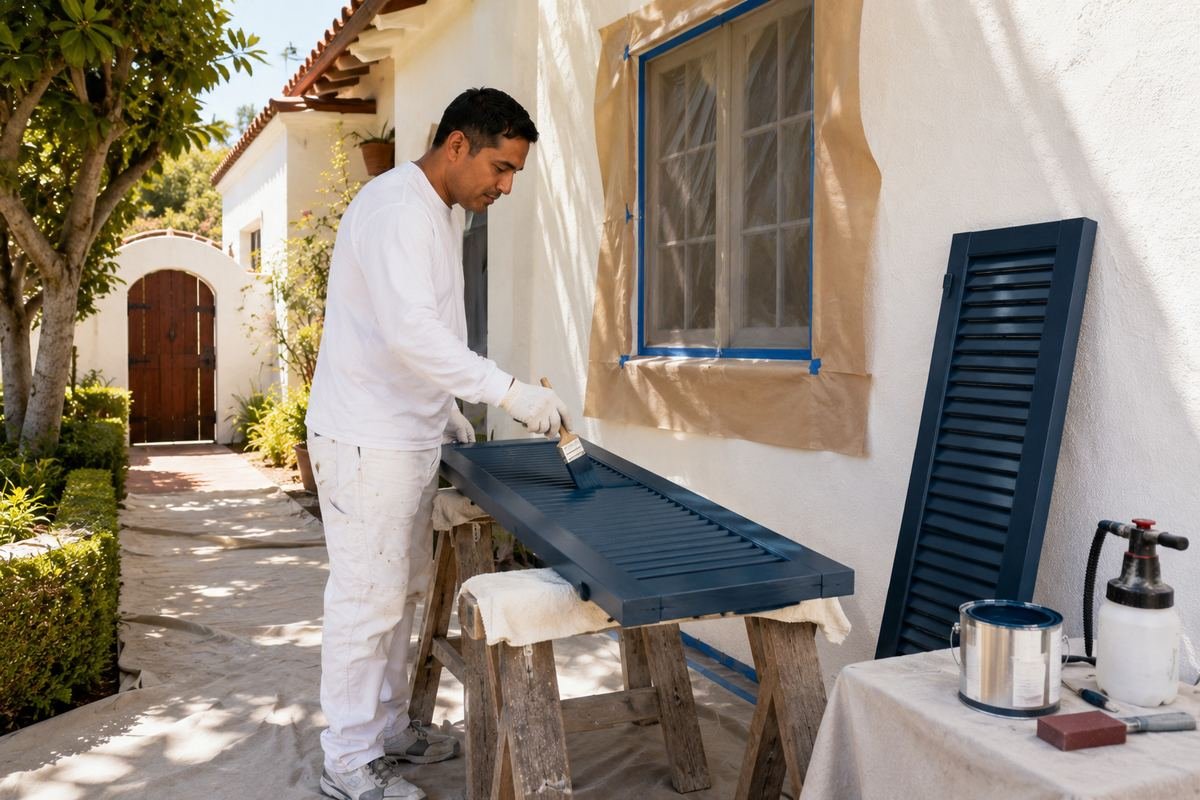
| Substrate | Appropriate coating | Why it matters |
|---|---|---|
| Original wood siding and trim | Alkyd or waterborne alkyd enamel | Cures by oxidative cross-linking and holds crisp detail on carved and dimensional woodwork |
| Lime plaster and traditional stucco | Limewash or mineral silicate coating | Fully vapour permeable, matches the soft historic look and will not trap moisture |
| Later stucco recoats, post-1970s | Elastomeric coating | Bridges hairline cracking on sound walls without the rigidity of a hard film |
| Exposed masonry, chimneys and piers | Breathable masonry paint or limewash | Prevents the efflorescence and spalling that trapped moisture produces |
| Wood window sash and glazing | Linseed putty and enamel over primed timber | Keeps water out of the joint, which is where sash failure always starts |
02
Restoration mistakes we get called in to fix
Because Craftsman and period revival houses look sturdy, it is easy to treat them like any other exterior. A handful of well-intentioned choices cause most of the damage we see.
- Sealing lime plaster or historic stucco with a modern non-breathable film. It looks fine for a season or two, then moisture trapped behind the coating blisters and cracks the surface from the inside out, which is a far bigger repair than the original repaint would have been.
- Aggressive power washing or mechanical stripping on original wood. Fast, and it gouges soft century-old grain and rounds off the crisp edges of hand-cut brackets and rafter tails that give the trim its character.
- Skipping design review documentation. Properties in Bungalow Heaven and comparable districts can need colour approval before work starts, and skipping it can mean redoing work that never had sign-off.
- Choosing a generic historic-sounding colour. Craftsman palettes varied by builder and by decade. A colour that reads correctly on one bungalow can be wrong for the next block or the next ten years of construction.
- Coating over failing mortar or active efflorescence. A fresh coat over a live moisture problem delays the visible damage rather than stopping it.
Our process is built to avoid each of those, starting with a historic assessment before any preparation begins.
03
What shapes a restoration project, and how it runs
On a period house the variables are different from a standard repaint, and most of them are about what survives rather than what is being applied.
Original material remaining
Houses with intact original siding and trim need far more careful hand preparation than ones where replacement material has already gone in. More survival means more labour, and it is usually worth it.
Existing coating layers
Older homes carry many historic layers, some needing careful removal rather than aggressive stripping. Where the stack has alligatored, spot-stripping beats adding another coat on top of a failing one.
Detail, review and access
Extensive rafter tails, brackets and battered piers take longer to prepare and coat by hand. District design review adds a step. Steep hillside lots in Altadena and the San Rafael Hills add access considerations.
Historic assessment
We evaluate the condition of original material, the existing coating layers, and any design review requirements attached to the district or the property before anything else is discussed.
Colour and coating research
Palettes and systems appropriate to the construction era and the actual materials, rather than a generic period look applied to every house of a similar age.
Written scope and proposal
Preparation method, coating system and sequencing, with approval steps noted where a district requires them so the timeline reflects reality.
Careful preparation
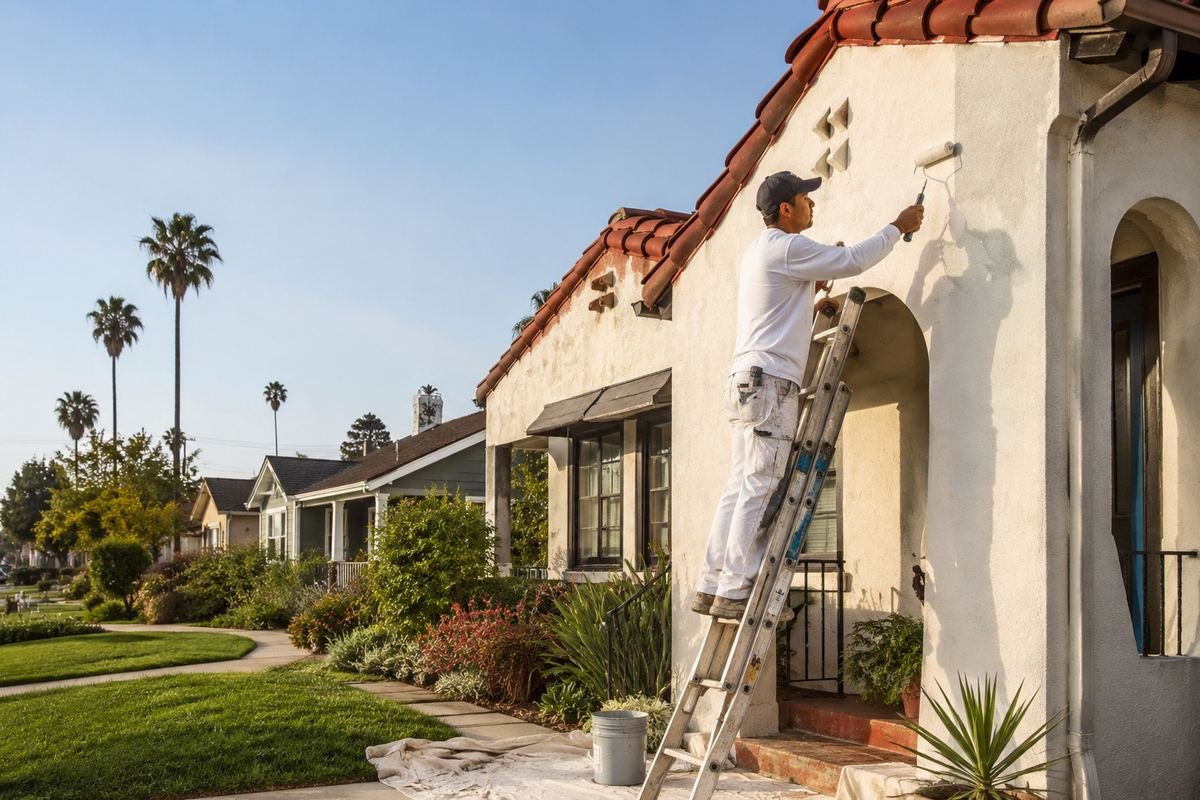
Hand scraping and sanding calibrated to protect original wood detail and stucco texture. Pre-1978 substrates run under lead-safe practices, which is the norm rather than the exception on a house of this age.
Application
Brush work is standard on detailed trim, because it preserves dimensional detail that spray softens. Broader siding and stucco areas may be rolled or sprayed depending on texture and access.
Final walk-through
The finished restoration reviewed with you detail by detail, which on a Craftsman elevation means a lot of details.
04
Frequently asked questions about historic restoration painting
What is the difference between a standard repaint and a restoration repaint?
A standard repaint prioritises coverage and speed. A restoration repaint prioritises the survival of original material: preparation methods chosen to protect century-old wood and plaster rather than strip them quickly, coatings matched to how the house was actually built, and a colour approach based on the property rather than a current fashion. The work is slower and the difference is visible from the pavement.
Do you work on homes in districts like Bungalow Heaven?
Yes, regularly. We are familiar with historic district design review and can supply colour samples, coating specifications and scope documentation to support an approval submission. The review itself is run by the district or the city rather than by us, so we build the approval window into the schedule rather than assuming it away.
Should damaged original wood trim be repaired or replaced?
Repaired wherever it genuinely can be, because original material is the thing that makes the house what it is. Dutchman repairs, consolidation and piecing-in can save a great deal of trim that looks beyond help. Where a section has gone structurally soft, replacement in matching profile is the honest answer, and we will tell you which case each piece is.
Can you match my home’s original paint colour?
Often, yes. Original colour survives in sheltered places: under a porch ceiling, behind a downpipe, on the back face of a shutter. We take a sample from an unfaded area and research palettes appropriate to the construction era, then put sample areas on the actual elevation. Where no evidence survives, we work from what is documented for houses of that type and period.
Is lead paint a concern on a house of this age?
It should be assumed until testing says otherwise on anything pre-1978, and in practice on Pasadena’s pre-1930 stock that means nearly always. Work runs under lead-safe practices: no dry open sanding, contained debris, sheeted ground and careful cleanup. It slows the job and it is not negotiable on a surface that is being disturbed.
Why does breathability matter so much on an old house?
Because these walls were built to let moisture move through them rather than to block it. Lime plaster, traditional stucco and solid masonry all dry outward. Seal that surface with a modern impermeable film and the moisture still arrives but can no longer leave, so it pushes the coating off from behind and damages the substrate underneath. Vapour-permeable systems work with the wall instead of against it.
How long does a period exterior take compared with a normal one?
Considerably longer, and almost all of the difference is preparation. Hand scraping detailed trim, re-glazing sash, consolidating soft timber and working under lead-safe containment take time that a straightforward stucco house simply does not need. We give you a realistic duration at the estimate rather than an optimistic one.
Is there a guarantee on restoration work?
For restoration work, coverage is written into the estimate documentation and governed by our terms of service, because a sash repair and a full elevation carry different terms. Your estimator will explain what applies to the specific scope on your property.
05
Related painting services
Restoration work overlaps with the specialty finishes, particularly on properties with both masonry and plaster.
- Limewash & Mineral Coatings
- Brick & Masonry Painting
- Venetian Plaster & Specialty Finishes
- Exterior House Painting
- Interior House Painting
- Stucco Painting
Painting service areas
Restoration work concentrates in the older streets of Pasadena, South Pasadena, San Marino, Sierra Madre and Altadena, and we cover every community in our service area.
Restore your piece of Pasadena history
Original Craftsman woodwork and century-old plaster deserve a crew that understands why they were built the way they were.
- Free written estimate
- Original material repaired before it is replaced
- Licensed, insured and bonded